
SpaceX Board Lacks Mars Colonization Experience
The governance similarities and contrasts with Tesla's IPO

While there has been much written about Elon Musk’s SpaceX flouting traditional good corporate governance conventions in its planned IPO, it is noteworthy to compare how different it is to what Tesla Inc. (née Tesla Motors) looked like when it went public. Investors looking for a repeat of Tesla’s phenomenal stock performance will not have the same board structure or experience to guide it. And as ambitious as Musk’s potential $1 trillion pay package is for goals of colonizing Mars and extraterrestrial data centers, the market capitalization target portion over 15 years is only about 4x its $1.75-$2 trillion planned IPO price, a far cry from the nearly 400x Tesla has achieved since its 2010 listing.
One does not need fancy AI tools to uncover the Space Exploration Technologies (SpaceX) governance practices that raise concerns for at least some investors. Issues like dual class shares, approximately 85% voting rights vested with Musk including on unrealized share awards, controlled company status, Texas domicile and its more restrictive shareholder rights compared to Delaware, and an astronomical pay package.
In contrast, the fledgling Tesla with faster growth and a clearer addressable market had a mostly fairly-aligned board of directors to the company’s strategy and generally good governance practices designed to appeal to investors. While retrospectively one can criticize the oversight and control the Tesla board has exercised, the company had a range of experience to potentially help steer the company’s electric vehicle growth ambitions.
SpaceX Board Oversight
Running the SpaceX S-1 registration statement through Canbury’s ProxyPro platform, we can dig into the highlights and lowlights of the company’s governance. Starting with the board, which has only 3 of 9 (nominally) independent directors, all of whom have close ties to Musk.
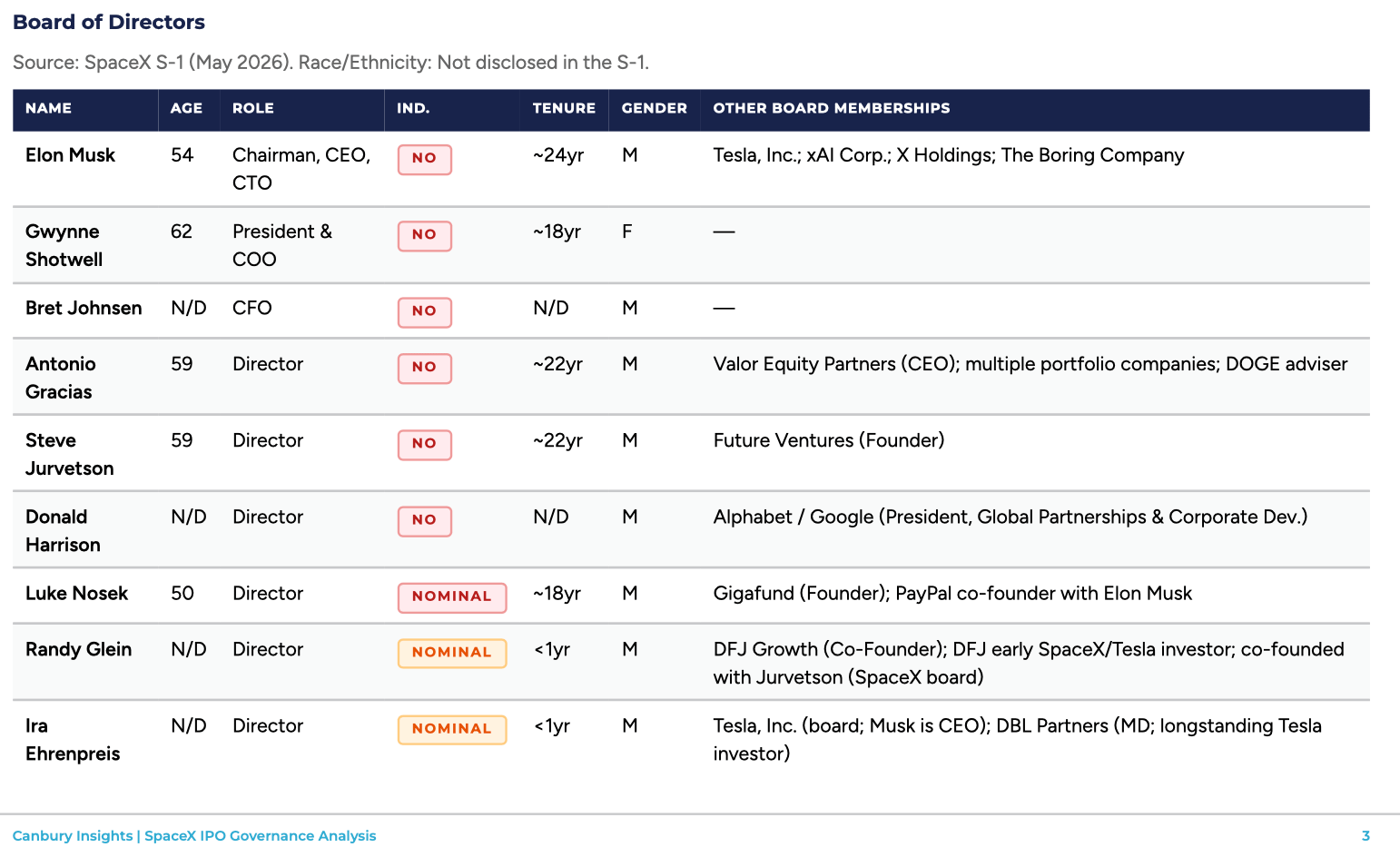
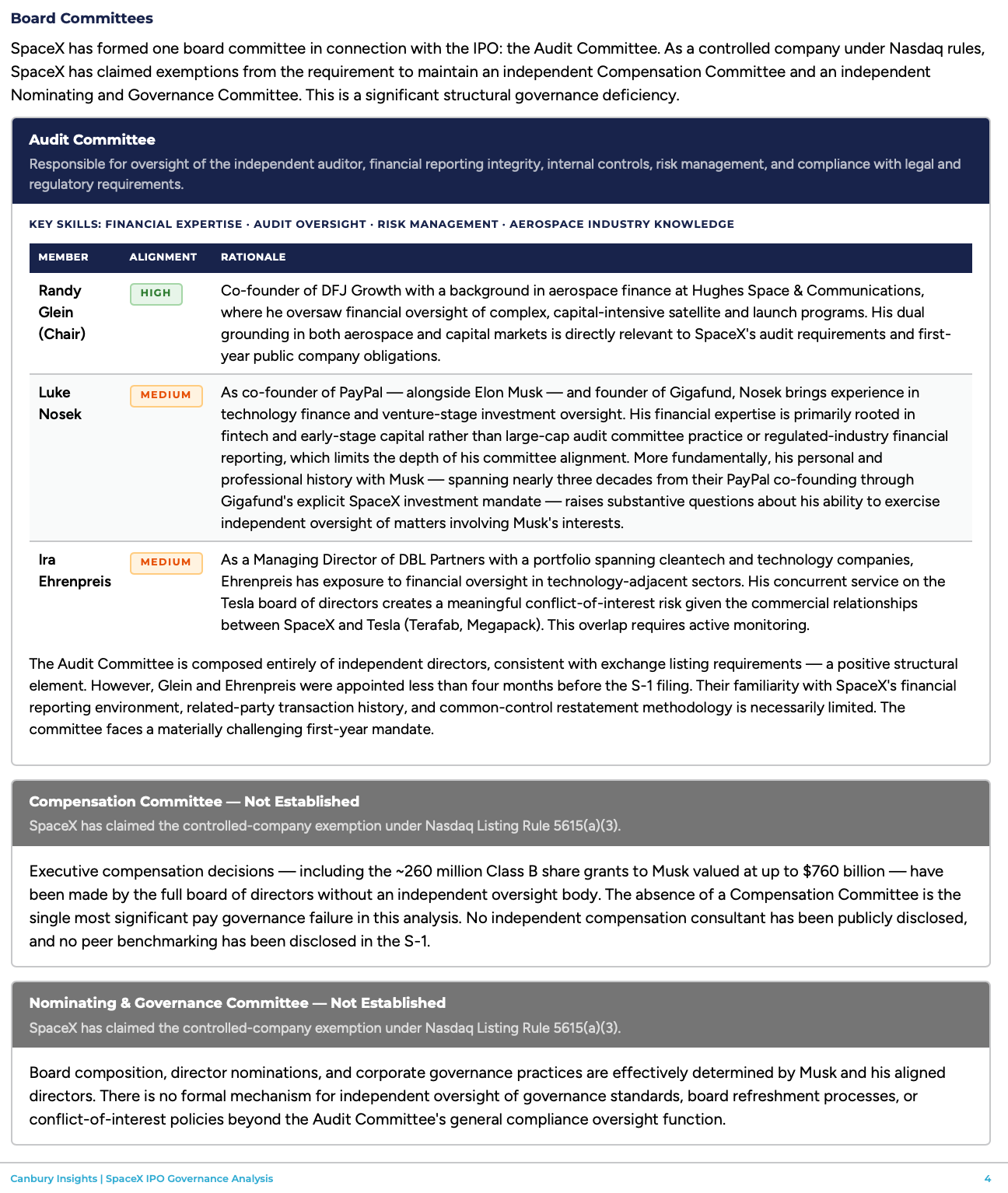
The only SpaceX board committee is a mandated audit committee, formed of the lone independent directors. As a controlled company, it can dispense with the normal necessities of a nominating and governance committee and compensation committee. Also, SpaceX has dispensed with a compensation consultant, which Tesla had at IPO, which may not be surprising given the pay program.
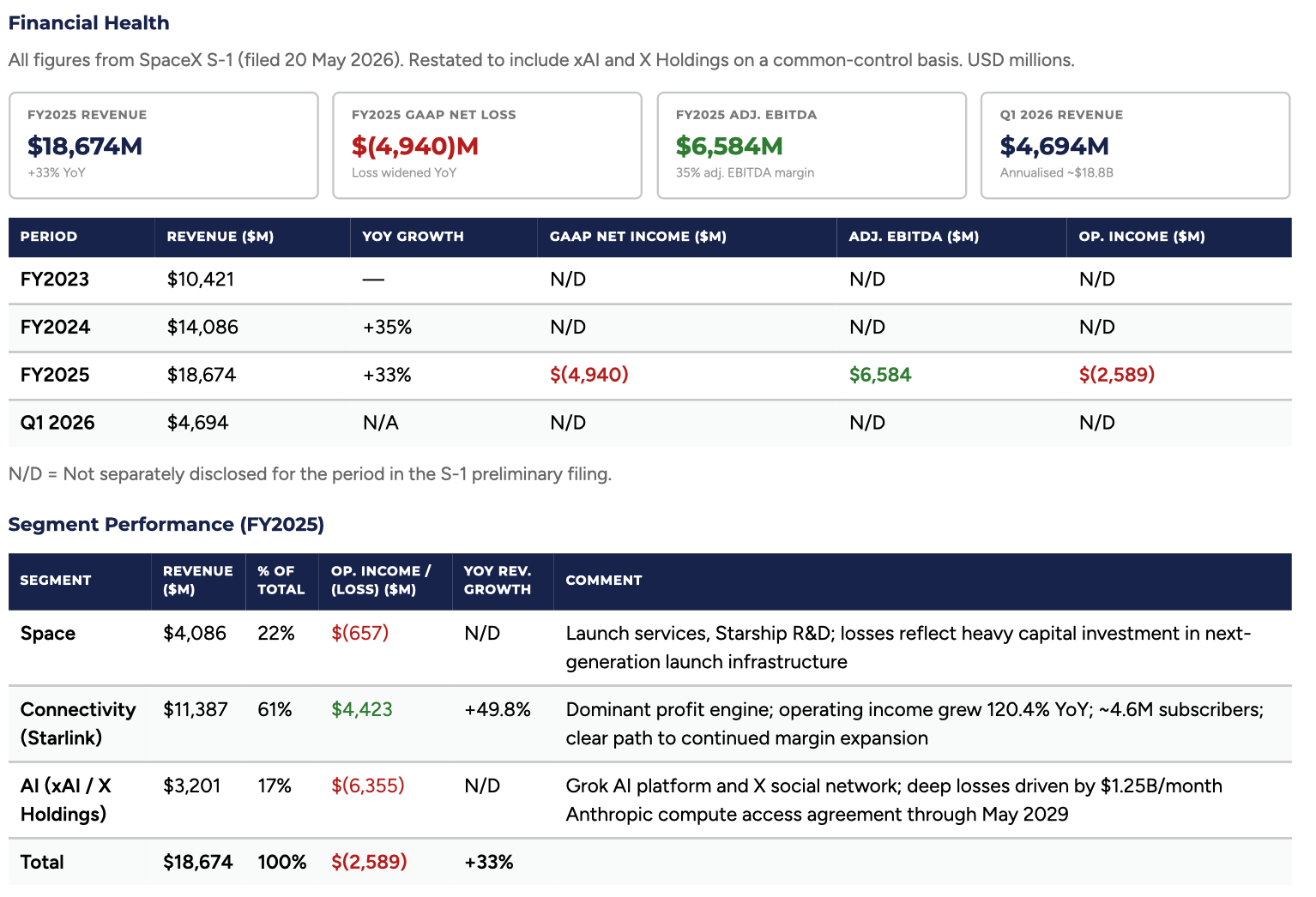
What is SpaceX and Can the Directors Guide its Strategy
Given SpaceX’s recent acquisition of Musk’s xAI, which itself acquired Musk’s X Holdings (née Twitter), a core question is what does SpaceX do?
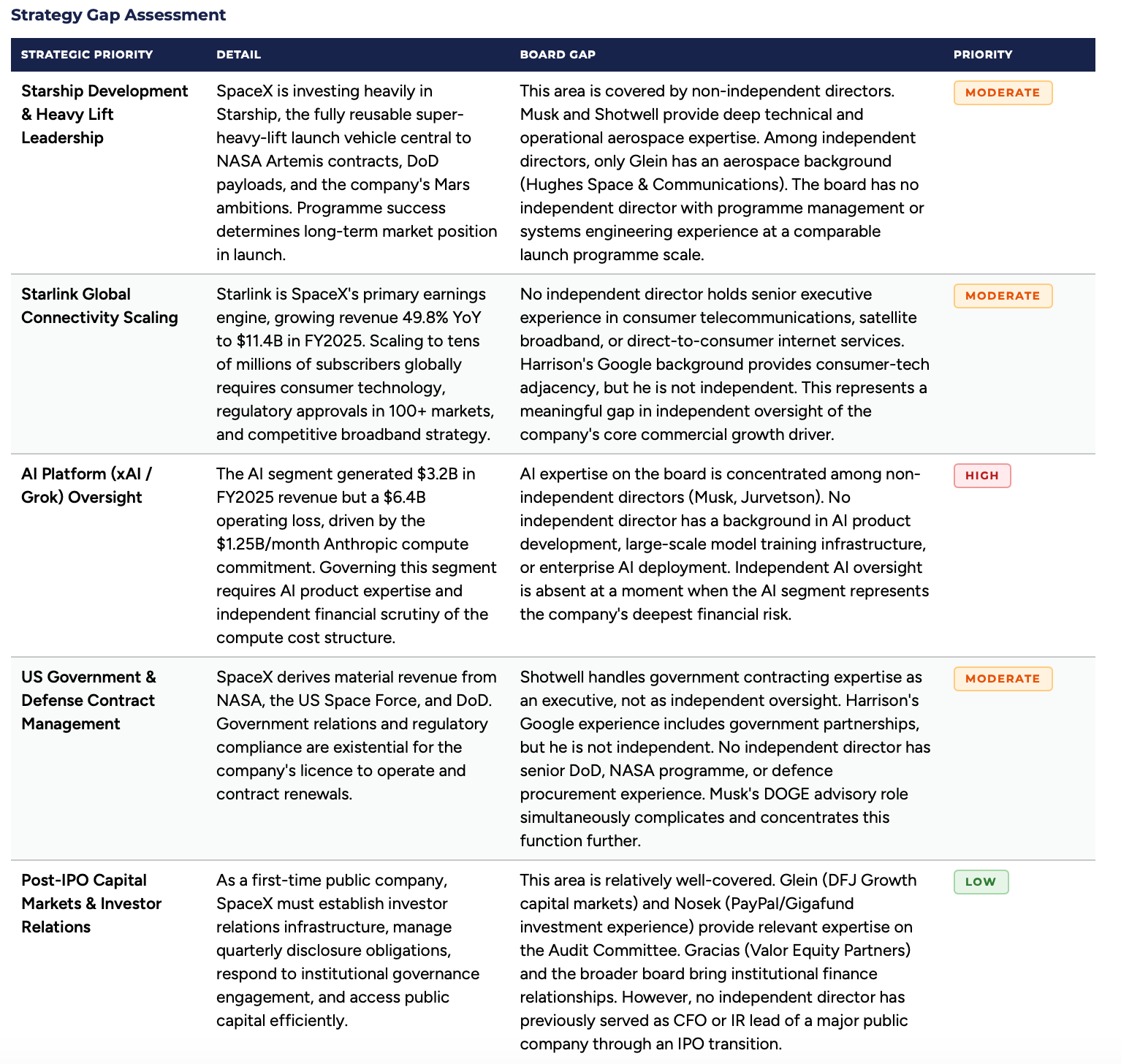
Using Canbury’s ProxyPro platform, we can use contextual analysis to extract the company’s key business priorities and then assess how its directors’ skill sets align with its strategy. It is worth noting that the directors (including executive directors) are strong on rocketry experience, there is less experience with AI. The non-executive directors are largely venture capitalists and technologists, who no doubt have AI investing experience, but not clearly the AI infrastructure experience that SpaceX is pivoting towards.
Mars-Shot Pay Package
Musk has redefined and inspired many imitators of his high-stakes, high reward moonshot pay packages. The SpaceX executive compensation package utilizes a 15-year, dual-key incentive structure that divides 1.3 billion restricted Class B shares across two parallel performance tracks. To unlock any single tranche, the company must concurrently hit escalating public market capitalization goals scaling up to $7.5 trillion alongside wholly unique operational milestones of 100 terawatts of non-Earth orbital AI compute and a goal of a 1-million-person permanent Mars colonization. While Elon Musk is granted immediate voting control over the entire share pool on day one of the listing, he will receive zero financial equity if the company clears its valuation metrics but fails to achieve the specified technological and planetary benchmarks.
Although, without a compensation committee, it is always possible that the goals could be reset…
The Tesla Contrast
While Tesla Motors at its IPO in 2010 definitely had some governance demerits, it generally had standard practices, especially compared to many founder-led tech companies. Tesla had equal voting rights, a majority independent board (maybe some directors one could quibble with), and directors with business-relevant experience. It, of course, had some less popular practices, like staggered elections, no women directors, and brother Kimbal Musk on the board.
Running Tesla’s S-1 through our ProxyPro platform, there were definitely some directors with links to Musk (Antonio Gracias and Stephen Jurvetson – were on the board of SpaceX then and still are now!).
There were also directors who brought directly relevant auto manufacturing, energy sector and international experience. A lot of the heavy lifting was done by a single director from Daimler, Herbert Kohler, who was non-independent as the company was an over 5% holder, but directly relevant experience nonetheless.
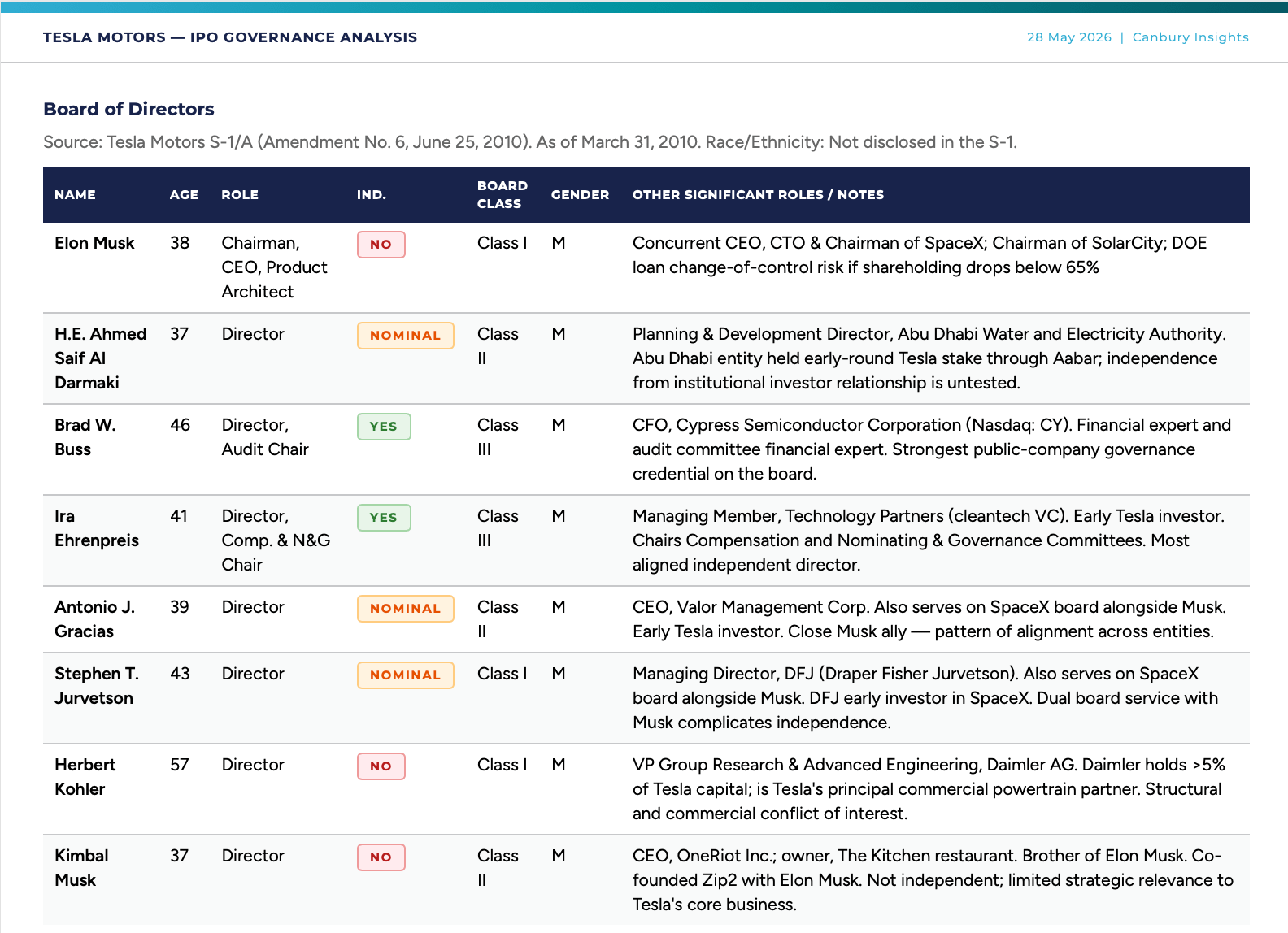
Given the “production hell” Tesla later faced scaling up to the high-volume Model 3 in 2017/18, it retrospect it could have probably used more automotive manufacturing experience on the board and in operations (note that the Daimler director Kohler left the board in 2012).
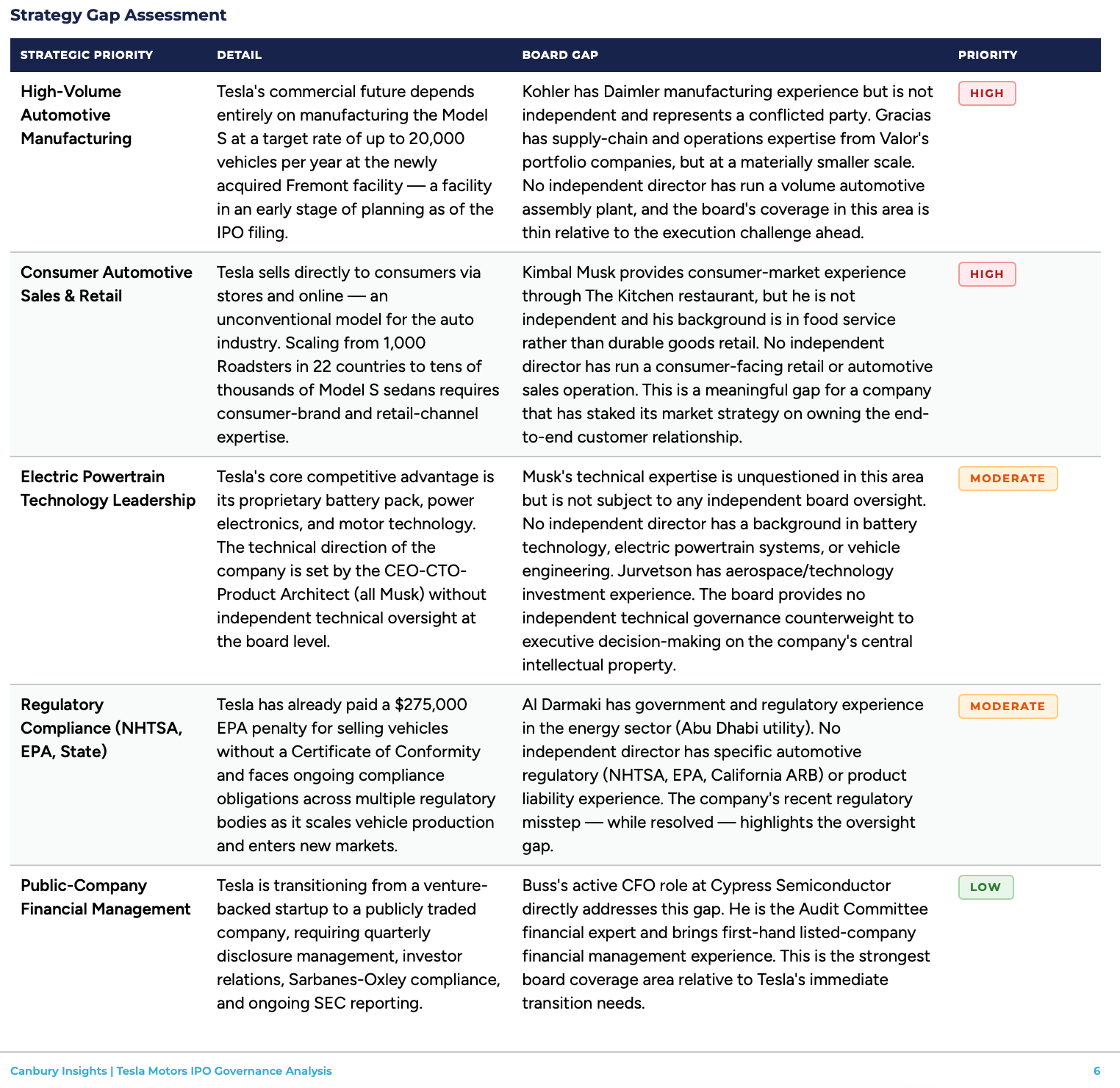
At this point, any investor in SpaceX knows what they are getting from Musk in terms of governance. One is not there for the director oversight, but rather if they can guide/enable the continued financial performance of the Musk-verse.
Full disclosure, I am nearing the end of my second Tesla Model 3 lease and I have not driven a better EV, or any similarly priced vehicle. I have yet to fly on a SpaceX rocket.
This post is provided for informational purposes only and does not constitute investment advice, financial guidance, or a recommendation regarding how to vote on any proxy proposal. While the analysis and figures presented are derived from public SEC filings and company reports and are believed to be accurate at the time of publication, they are provided without guarantee or warranty. Readers should conduct their own independent research and consult with a qualified professional before making any financial or voting decisions.
About Canbury
Canbury Insights is a technology-enabled sustainability consultancy applying AI tools to thoroughly and cost-efficiently deliver sustainability projects. We combine global expertise and local delivery to support organisations across the world to find the value in sustainability.


Copyright © 2026, Canbury Insights Limited. All rights reserved.